

Ethiopia’s gross domestic product rebasing, unveiled in Addis Ababa on 4 November 2026, raised the estimated size of its economy for fiscal year 2024/25 by 59.21%. The Ministry of National Strategy revised nominal GDP from 15,094.42 billion birr under the old series to 24,031.07 billion birr, adding nearly 8,937 billion birr to the accounts. The change immediately reshapes the ratios used to assess government debt and revenue, without altering the amounts owed under loan agreements.
The country moved its statistical base year from 2015/16 to 2024/25, using new censuses, household surveys and administrative records. Both figures therefore measure the same fiscal year at current prices. The updated accounts capture more informal activity, small businesses and digital services that were incompletely reflected in earlier data.
In ETB billion
Select a bar to see its details.
Same fiscal year measured under two statistical bases.
Source : Ministry of National Strategy, High Level Report: 2017 EFY GDP Rebasing, November 2026
Download CSV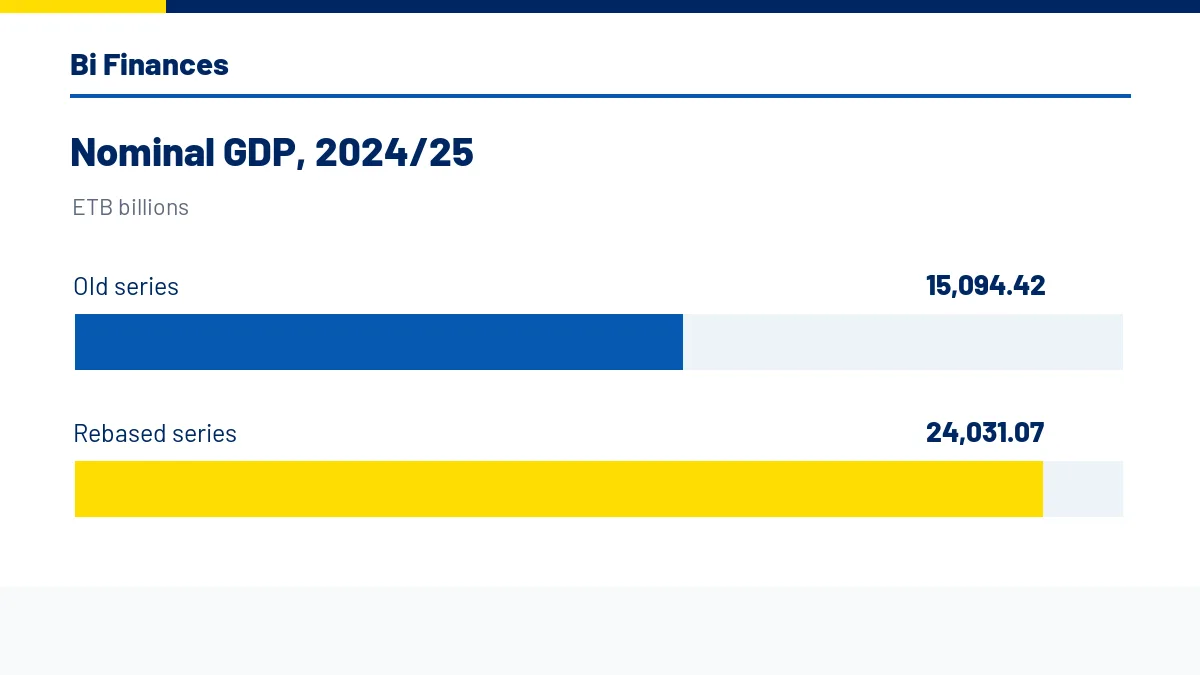
View data
| Category | ETB billion |
|---|---|
| Old estimate | 15,094.42 |
| Rebased estimate | 24,031.07 |
Debt looks smaller in the ratios, not in loan contracts
For an unchanged stock of debt, a debt-to-GDP ratio calculated with the revised GDP would be approximately 37.2% lower than one based on the previous estimate for 2024/25. This follows directly from the ratio between the two GDP levels reported by the ministry. Principal, interest and repayment dates remain governed by the country’s existing financial obligations.
The denominator effect matters for Ethiopia, which is pursuing an external debt restructuring while creditors also scrutinise foreign-exchange availability and repayment capacity. Economist Abdulmenan Mohammed, interviewed by the Ethiopian newspaper Capital in an article published on 8 November, said export performance remained important to negotiations with creditors.
The same arithmetic lowers the tax-revenue-to-GDP ratio when unchanged collections are measured against a larger economy. The ministry’s report presents the revised statistical base as a tool for improving domestic revenue mobilisation. It offers a fuller map of activities available for taxation, particularly where older estimates missed production and services.
Industrial activity gets a major statistical revaluation
The additional recorded activity is unevenly distributed. Industry’s nominal value added is revised upward by 73.2%, compared with 53.1% for agriculture and 56.3% for services. Industry’s share of GDP consequently rises from 27.8% in the old series to 30.2% in the new one, while agriculture accounts for 31.57% and services for 35.91%.
In Statistical revision (%)
Select a bar to see its details.
Revisions in levels for the same fiscal year 2024/25.
Source : Ministry of National Strategy, High Level Report: 2017 EFY GDP Rebasing, November 2026
Download CSV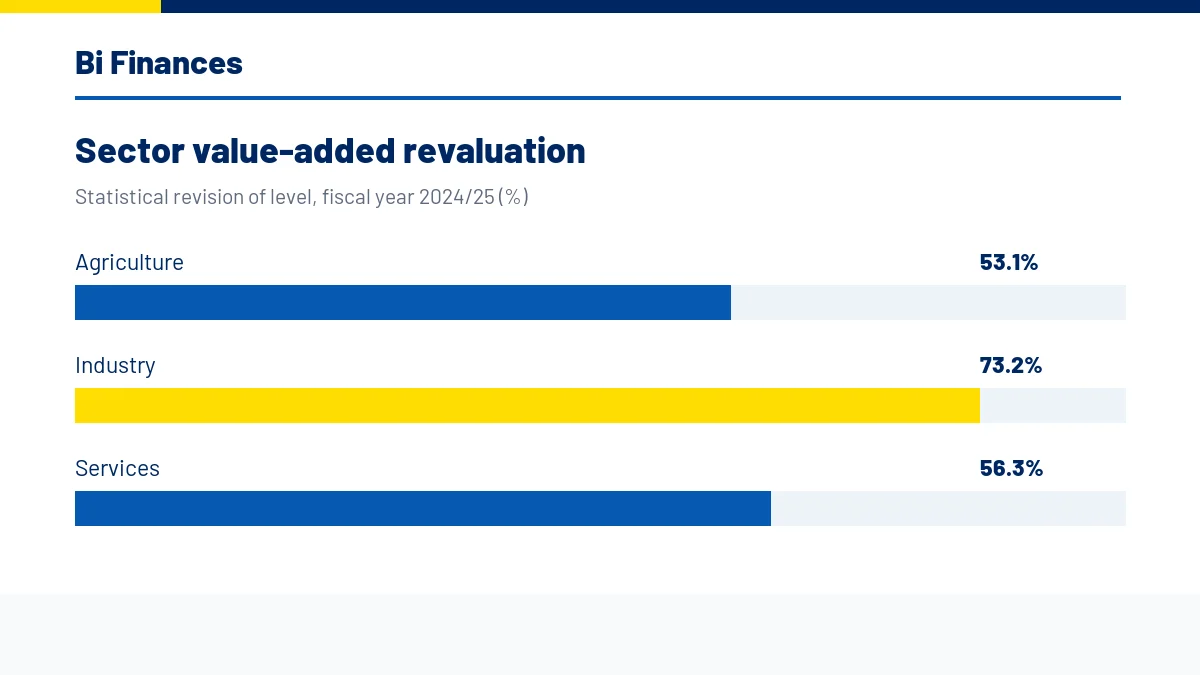
View data
| Category | Statistical revision (%) |
|---|---|
| Agriculture | 53.1 |
| Industry | 73.2 |
| Services | 56.3 |
The biggest adjustments concern activities that were difficult to capture. Mining and quarrying is revalued by 245.1%, manufacturing by 160.6%, and electricity and water by 495.4%. The ministry attributes these revisions to better coverage of artisanal extraction, small workshops, off-grid services and updated producer prices. The percentages compare two statistical estimates for 2024/25.
The overhaul also changes the picture of finance. Value added in financial services and insurance is estimated at 456.94 billion birr, down from 476.03 billion under the old series, a 4% downward revision. Meanwhile, the revised classification identifies telecommunications and information as a separate activity worth 326.72 billion birr, without a directly comparable standalone category in the previous tables.
Investment gains more than fifteen GDP percentage points
Gross capital formation is estimated at 8,486.76 billion birr in the revised accounts, against 3,036.99 billion previously. Its share of GDP jumps from 20.1% to 35.3%, an increase of 15.2 percentage points. The report links the adjustment to establishment surveys, investment by regional state-owned enterprises and improved asset coverage.
In Percent of GDP
Select a bar to see its details.
Gross capital formation, fiscal year 2024/25.
Source : Ministry of National Strategy, High Level Report: 2017 EFY GDP Rebasing, November 2026
Download CSV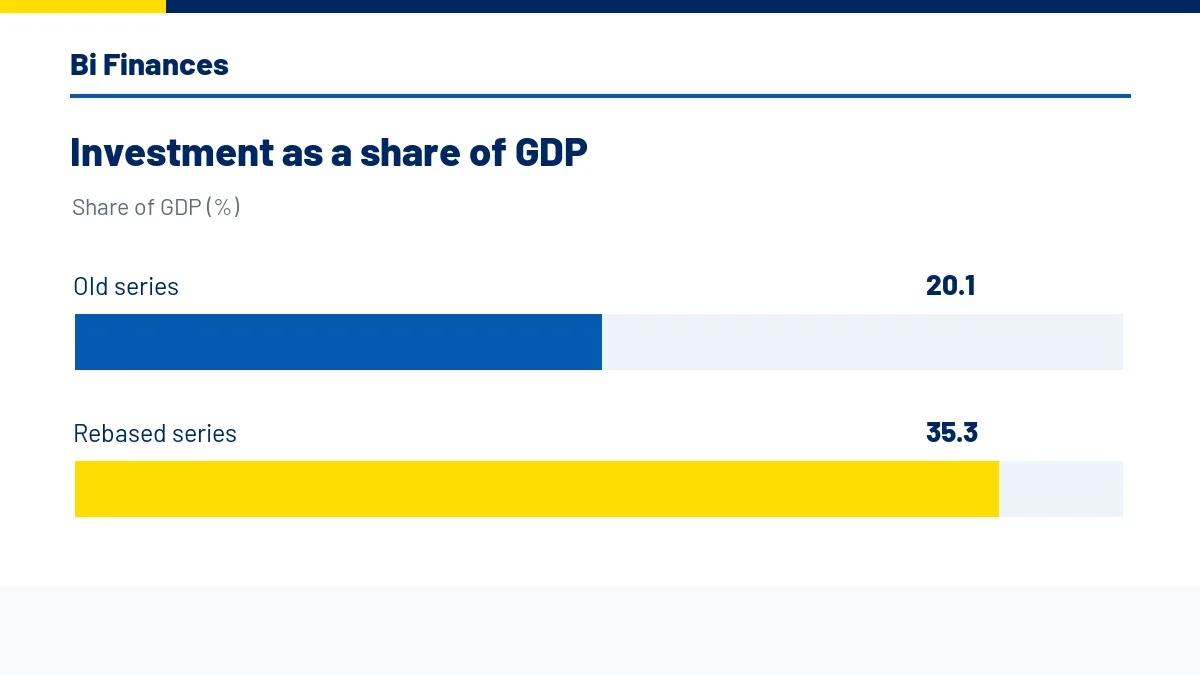
View data
| Category | Percent of GDP |
|---|---|
| Old estimate | 20.1 |
| Rebased estimate | 35.3 |
Private final consumption moves in the opposite direction as a share of the economy. Its nominal level is revised from 12,216.35 billion to 15,473.10 billion birr, yet its GDP share falls from 80.9% to 64.4%. Investment and consumption thus occupy markedly different positions in the revised national accounts.
The measured external resource deficit is another example. It rises in nominal terms from 1,040.35 billion to 1,065.63 billion birr, while falling as a share of GDP from 6.9% to 4.4%. The deficit is slightly larger in birr under the new figures, even as its relative weight declines with the higher GDP estimate.