

Cameroon's real gross domestic product rose by 1.6% in the first quarter of 2026, after stagnating in the fourth quarter of 2025, according to accounts published on 5 November by the National Institute of Statistics (INS). These quarterly changes are adjusted for seasonal effects and working days. Volume series use 2016 as the base year.
Year on year, activity rose by 3.4%. The recovery rests in particular on services and the revival of private consumption. It is, however, accompanied by opposing movements in investment, with growth in its private component and a further contraction in its public component.
Services drive the momentum
Value added in the tertiary sector rose by 2.2% over the quarter, ahead of the primary sector at 1.3% and the secondary sector at 0.9%. Services contributed 1.1 percentage points to overall growth. Transport, financial activities and public administration were among their main supports.
In %
Select a bar to see its details.
Quarterly changes in volume, seasonally and working-day adjusted. These rates are neither shares of GDP nor contributions to its growth.
Source : INS Cameroun, Q1 2026 compared with Q4 2025
Download CSV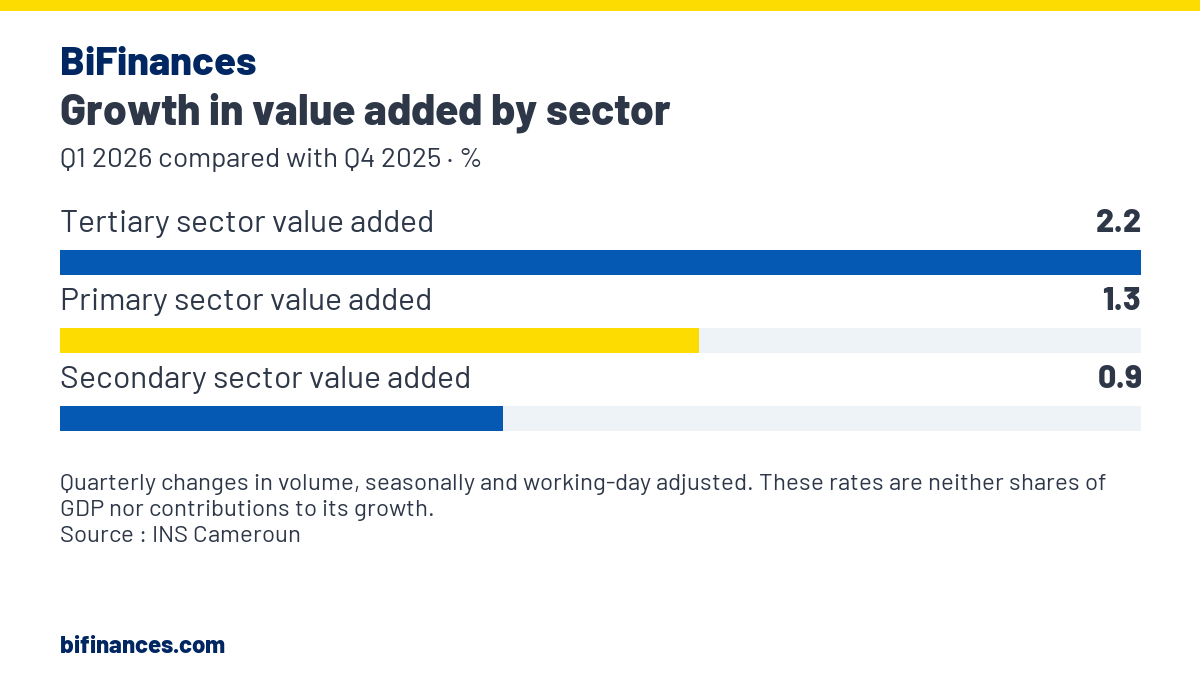
View data
| Category | % |
|---|---|
| Tertiary sector value added | 2.2 |
| Primary sector value added | 1.3 |
| Secondary sector value added | 0.9 |
Growth in the secondary sector masks differing situations. Building and public works, water and sanitation, and agri-food industries supported activity. They offset the decline in extractive industries and other manufacturing industries.
The leading role of services extends what was seen in the annual results published on 2 September. For 2025, the INS estimated economic growth at 3.5% and tertiary growth at 4.3%. The start of 2026 thus finds sectoral support that was already decisive the previous year.
Private consumption picks up, imports too
On the demand side, private consumption rebounded by 2.6% after a fall of 2.2% in the last quarter of 2025. Public consumption also increased. Together, these movements lifted growth in final consumption to 2.8% over the quarter.
Total investment rose by 5.9%, driven by a 6.4% increase in its private component. Public investment fell by 27.7%, extending the contraction seen at the end of 2025. The improvement in overall investment therefore coexists with a persistent decline in public effort as measured by the accounts.
Purchases from abroad are also rising sharply. Imports of goods and services increased by 10.2% in volume over the quarter, supported in particular by machinery and furniture. Exports rose by only 0.6%, a gap that widens the deficit in external trade, according to the INS.
This weak export growth masks a contrast between its components. Sales of services abroad rose by 13.1% and offset a 3.6% fall in goods exports. Crude oil, other manufactured products and logs were among the products whose exported volumes declined.