

Côte d’Ivoire inaugurated Atinkou on 6 November in Taboth, near Jacqueville. The Ministry of Energy presents a production potential of 2,875 GWh per year and puts the installed capacity of the national fleet at 3,337 MW.
The review reports 1,934 GWh injected in 2025, against a contractual commitment of 1,880 GWh. Commercial operation of the combined cycle began on 13 December 2025.
In GWh
Select a bar to see its details.
Deliveries made and the contractual benchmark for the same year. These values are not components to be added together.
Source : Ministère ivoirien de l’Énergie, 2025
Download CSV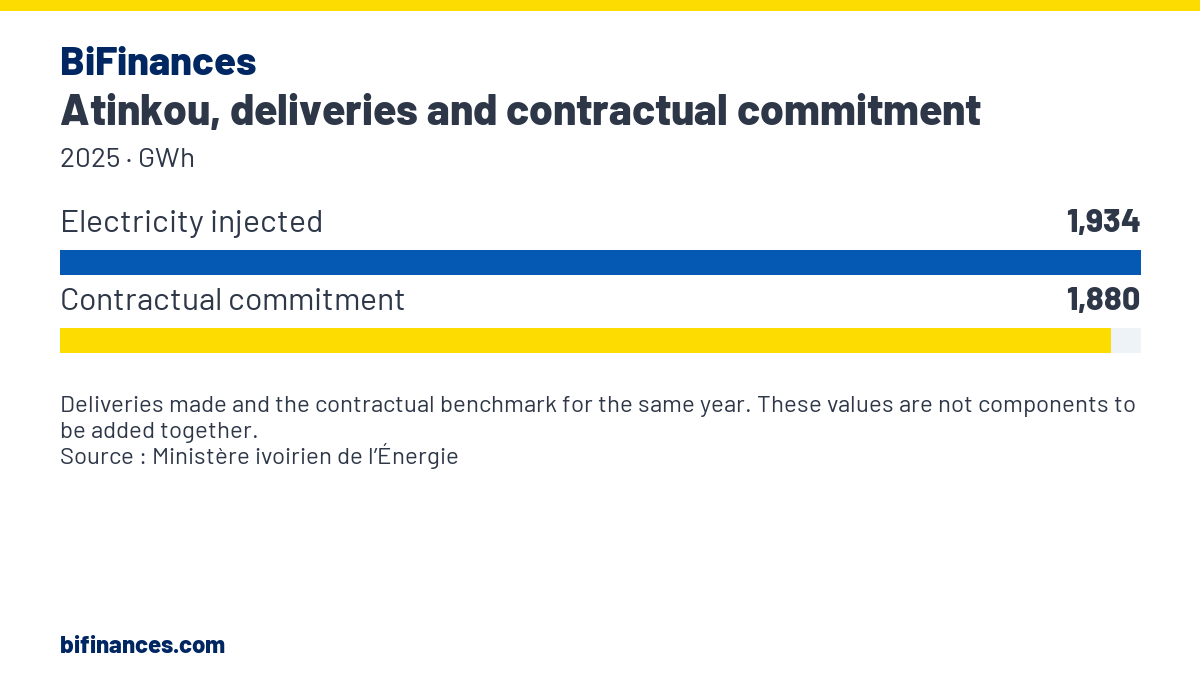
View data
| Category | GWh |
|---|---|
| Electricity injected | 1,934 |
| Contractual commitment | 1,880 |
The operator’s history traces this ramp-up. It places the first injections from the gas turbine in June 2023, followed by production from the steam turbine in December 2025. The inauguration thus comes after several operational stages.
Recovering heat to produce more
The combined cycle relies on two successive stages of production. Natural gas first feeds a turbine. The residual heat from the flue gases is then recovered in a boiler, which turns water into steam to drive a second turbine. The operator explains that this stage supplies additional electricity without adding gas.
This process makes greater use of the energy in the fuel. Atinkou presents it as more efficient than an open-cycle plant and as a means of reducing CO₂ emissions per kilowatt-hour produced.
Financing arranged as early as 2020
Initial financing had been announced on 4 March 2020. The IFC had structured debt of 303 million euros, including a loan of 91 million for its own account, for a project whose announced total cost reached 404 million euros.
The arrangement was based on a twenty-year concession to develop and operate a 390 MW gas-fired plant about forty kilometres west of Abidjan. The IFC then linked high-efficiency technology to the replacement of old units and an expected reduction in production costs.
The annual potential announced at the inauguration now describes the scale of expected contribution to the grid. It is not a delivery result for 2026. The ministry specifies that the electricity is carried by the high-voltage line that encircles Abidjan.