

Kenya's tax authority exceeded its revenue target in October 2026, with 260.630 billion shillings collected against 258.304 billion expected. In its statement of 5 November, the Kenya Revenue Authority (KRA) reports a rise of 15.5% compared with October 2025.
In billion KES
Select a bar to see its details.
Same period and same aggregate. The chart does not present customs and domestic revenue as an exhaustive breakdown.
Source : Kenya Revenue Authority, October 2026
Download CSV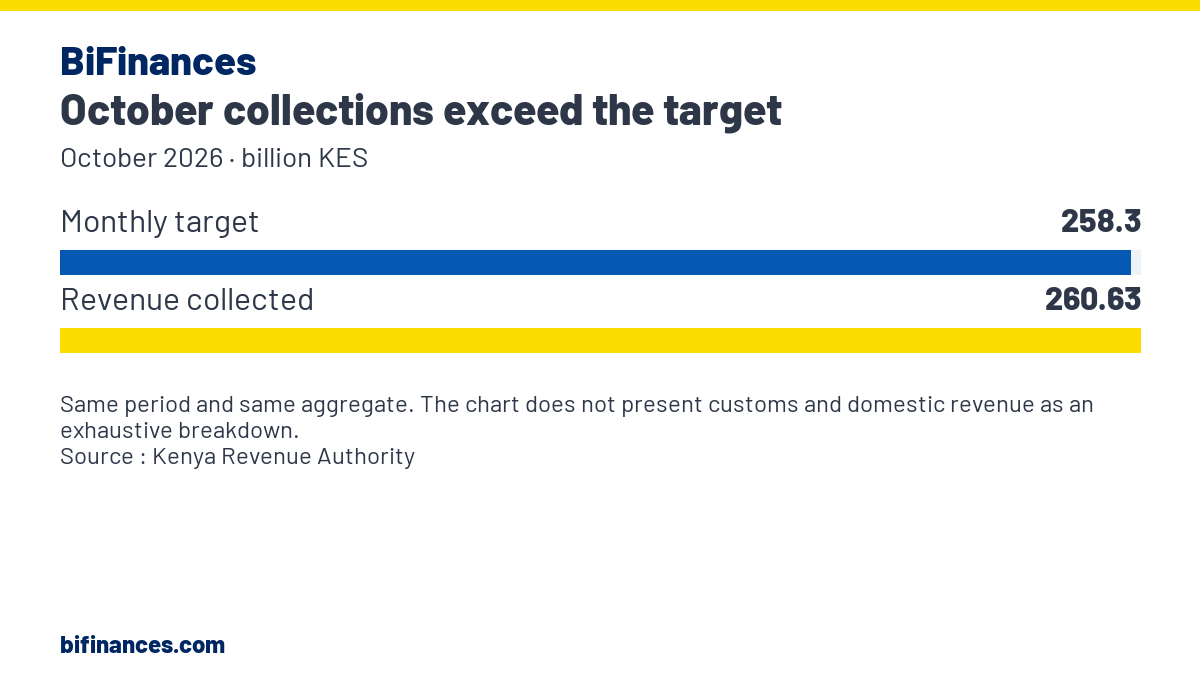
View data
| Category | billion KES |
|---|---|
| Monthly target | 258.3 |
| Revenue collected | 260.63 |
This result brings collections to 1,010 billion shillings over the first four months of the 2026-2027 financial year. It offers an interim picture of the resources raised to finance public spending, with the overshoot against the monthly target remaining below 1%.
Identified drivers and a gap in the breakdown
The KRA attributes the customs performance in particular to taxes on non-oil imports, up 26% year on year. On the corporate income tax side, electricity, manufacturing, transport and wholesale trade account for around 81% of October collections. The result therefore rests partly on specifically identified activities.
The breakdown, however, calls for a clarification. The statement gives 94.793 billion shillings for customs and 165.447 billion for domestic revenue. Their sum comes to 260.240 billion, or 390 million less than the announced monthly total. The KRA does not explain this gap in the document.
The annual target is set at 3,268 billion shillings. October's result is therefore a step forward in the financial year, while collections in the following months will determine the final outcome. Techweez, which reports the figures on 5 November, also underlines the effort still needed before the end of the budget year.
The previous year shows the importance of tracking targets. As at 31 March 2026, the KRA had collected 2,038 billion shillings against a target of 2,122 billion for the same period. That April statement therefore documented collections below forecast, despite annual growth. The overshoot recorded in October falls at a different stage of the budget and is not a direct comparison of the two cumulative totals.