

Annual inflation in Angola stood at 8.16% in October 2026, down from 8.43% in September, according to results published on 6 November by the National Statistics Institute. The slowdown amounts to 0.27 percentage point in one month, without erasing the rise in the cost of the consumption basket.
The contrast is starker with October 2025, when annual inflation stood at 17.43%. The rate has thus fallen by 9.27 points over one year. This disinflation means prices are rising more slowly. It does not mean a return to earlier price levels, since the basket measured remains more expensive than in October 2025.
Food drives price pressure on the basket
Food and non-alcoholic beverages remain at the centre of this rise. Their prices rise 9.28% year on year, and their contribution reaches 5.62 percentage points, or 68.86% of overall inflation. The weight of this item explains why the national slowdown can coexist with persistent pressure on food purchases.
Education shows an even stronger annual increase, at 15.82%. Health rises 9.05%, while transport increases 3.46%. These results describe very different trends depending on the type of spending, beyond the average rate alone.
In %
Select a bar to see its details.
Year-on-year price changes by consumption category. Selection of categories, without exhaustive breakdown or calculation of shares.
Source : INE Angola, October 2026
Download CSV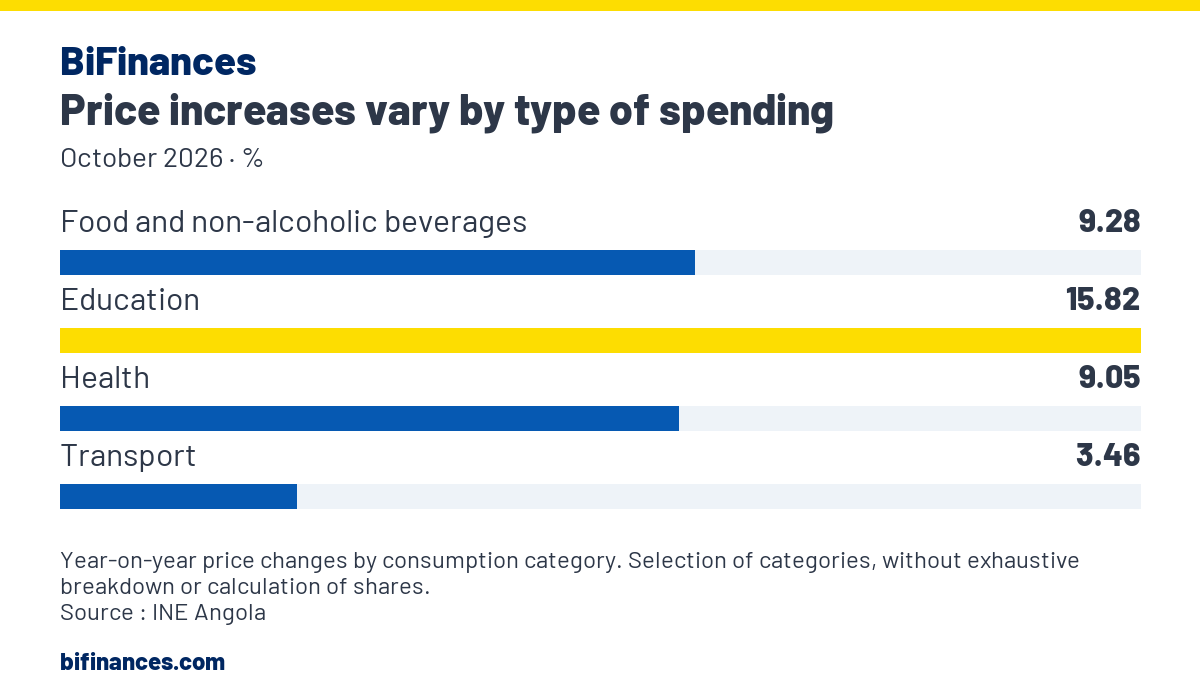
View data
| Category | % |
|---|---|
| Food and non-alcoholic beverages | 9.28 |
| Education | 15.82 |
| Health | 9.05 |
| Transport | 3.46 |
The weight of a category in inflation, however, cannot be read from its rate of increase alone. Despite faster price growth in education, its contribution to the overall index is 0.32 point, far below that of food. The report thus distinguishes the price rise specific to each item from its share in the change in the national basket.
Differences also exist between regions. The report records annual inflation of 12.47% in Cubango, compared with 5.97% in Cuanza Norte. The national figure of 8.16% therefore summarises contrasting local situations, just as it aggregates spending whose prices do not move at the same pace.