

African stock markets gained 49% in market capitalisation in 2025, yet the OECD counted only seven company listings across the continent during the year. In a report published on 6 November 2026, the organisation put the initial public offerings made by these new entrants at $1.007 billion. The surge in listed valuations stood in sharp contrast to the limited number of companies opening their capital to investors and the financing opportunities available to businesses.
Much of the gain came from higher valuations for companies already on stock exchanges. The OECD estimates that new listings accounted for only 3% of the increase in African market capitalisation in 2025. For a company seeking investment funds, rising prices for shares held by existing investors do not deliver the same financing as issuing new equity.
In Annual change (%)
Select a bar to see its details.
Change in 2025 market capitalisation versus 2024.
Source : OECD, Africa Capital Markets Report 2026
Download CSV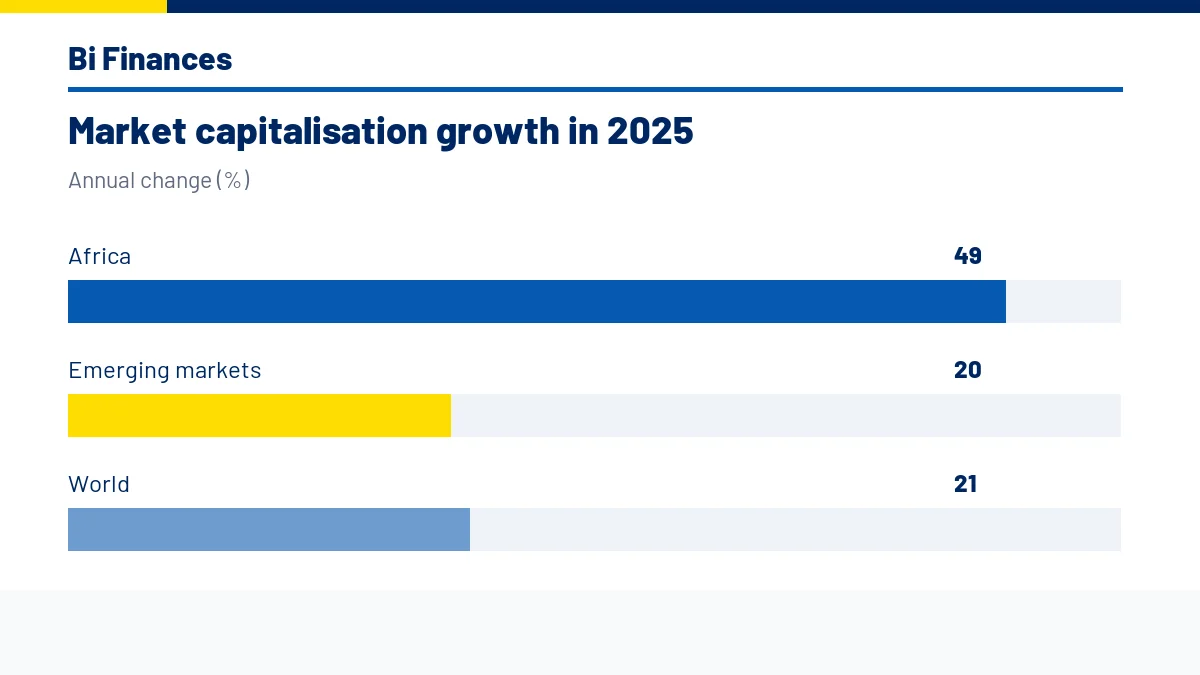
View data
| Category | Annual change (%) |
|---|---|
| Africa | 49 |
| Emerging markets | 20 |
| World | 21 |
Market values grow faster than the number of companies
Africa’s market capitalisation grew more than twice as fast as that of emerging markets, which gained 20%, and the global market, which rose 21% in 2025. Ghana led with a 153% increase, followed by Zambia at 111% and Nigeria at 77%. Higher prices for certain mining stocks, supported by stronger metals markets, and improving investor expectations contributed to the gains.
The growth was highly concentrated. At the end of 2025, South Africa alone accounted for nearly 60% of Africa’s listed market value. Together with Morocco, Egypt and Nigeria, it represented 88% of the total. Listed equity capitalisation amounted to 43% of African GDP, compared with 68% across emerging markets and 128% globally.
The listings were concentrated too. The OECD’s seven recorded IPOs were in Egypt, Ghana, Morocco and South Africa. Morocco hosted three offerings worth a combined $658 million, close to two-thirds of the continent’s initial public offering proceeds in the report. Ghana completed its first recorded IPO since 2020.
Existing listed companies dominate fresh equity issuance
New entrants were not the only companies looking to stock markets for funds. In 2025, 38 already-listed companies raised $5.696 billion through follow-on equity offerings, up from $4.7 billion in 2024. These subsequent share issues raised more than five times the amount recorded for initial public offerings in the OECD data.
In USD millions
Select a bar to see its details.
Initial and follow-on offering proceeds, separate issuance categories.
Source : OECD, Africa Capital Markets Report 2026
Download CSV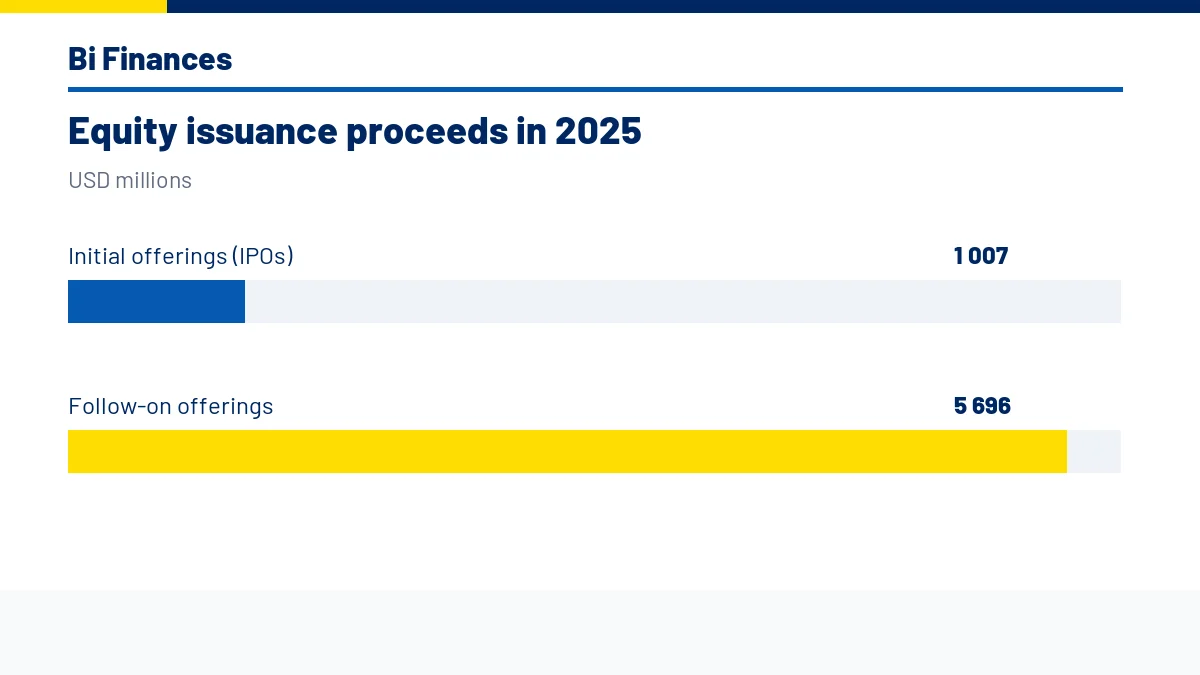
View data
| Category | USD millions | % |
|---|---|---|
| Initial offerings (IPOs) | 1,007 | 15.02 |
| Follow-on offerings | 5,696 | 84.98 |
The activity was far from evenly distributed. Eleven South African companies raised $4.294 billion through follow-on offerings, about three-quarters of the African total. Nigeria and Egypt also featured among active markets, while many other exchanges reported little or no comparable issuance.
Trading in existing shares showed a similar concentration. The OECD found that the most liquid markets, in Morocco, South Africa and Egypt, had turnover ratios ranging from 13% to 42% in 2025. Every other market it examined remained below 9%, limiting investors’ ability to sell sizeable holdings quickly and making public listings less appealing to potential issuers.
At the BRVM, rising valuations tell only part of the story
The shared exchange of the eight WAEMU countries offers a regional comparison. According to its 2025 annual review, the BRVM’s equity market capitalisation rose 32.27% to CFAF13,330.71 billion, while its Composite index gained 25.26%. Yet the combined value of trading in shares and bonds fell 23.89%, from CFAF461.53 billion to CFAF351.29 billion. The increase in listed company valuations therefore coincided with a decline in the exchange’s total traded value across its two market segments.
In CFAF billion
Select a bar to see its details.
Combined equity and bond market trading, calendar years.
Source : BRVM, official 2025 review
Download CSV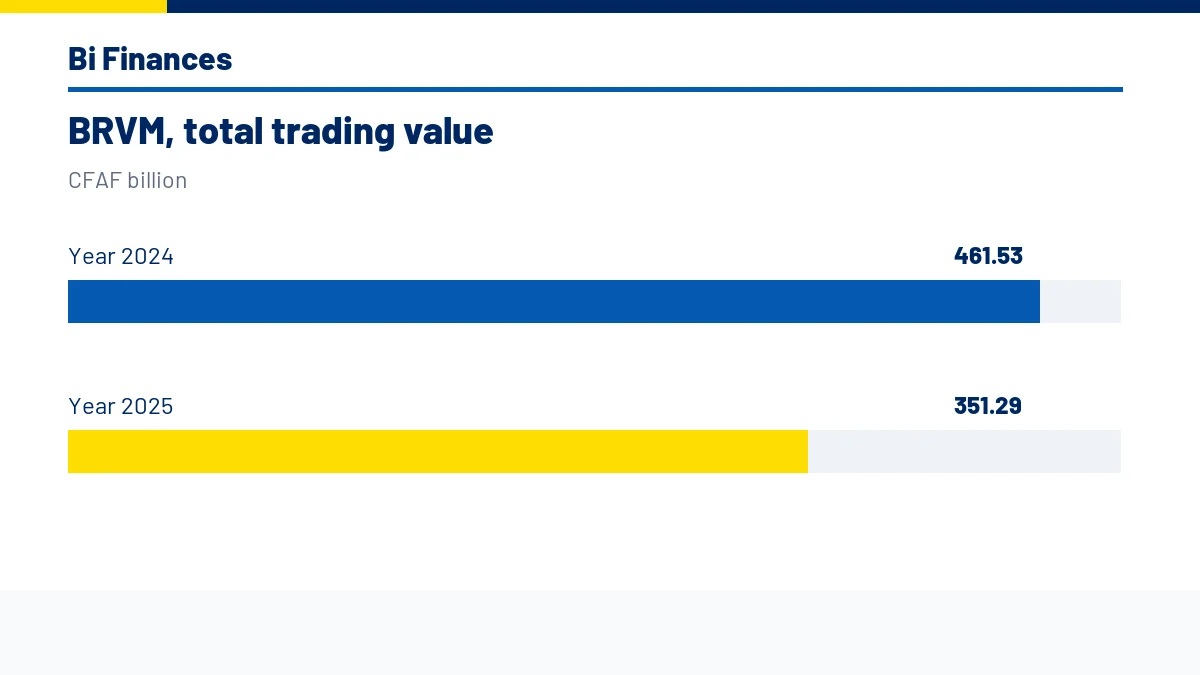
View data
| Category | CFAF billion |
|---|---|
| Year 2024 | 461.53 |
| Year 2025 | 351.29 |
Benin nevertheless provided one of the region’s major transactions. Banque internationale pour l’industrie et le commerce du Bénin (BIIC) joined the BRVM on 28 April 2025 after a public share sale that mobilised CFAF100.45 billion. The bank was valued at CFAF323.45 billion on admission. The Beninese state sold part of its existing stake, receiving the proceeds as the selling shareholder.
The admission is documented by official BRVM and Benin government announcements, whereas the OECD’s list of seven African IPOs does not include a Benin-domiciled transaction. Comparing the two primary sources points to differences in the statistical coverage of stock-market admissions and equity offerings across Africa.
Large shareholders still dominate ownership
Access to stock markets is also shaped by who owns shares in companies already listed. Corporations hold 23% of Africa’s listed equity, compared with 9% globally, while institutional investors own only 21%, against a worldwide share of 47%. The public sector accounts for a further 19%. Large strategic stakes can restrict the volume of shares available for ordinary trading and limit the breadth of the investor base.
Listing costs and disclosure requirements weigh more heavily on smaller companies. The OECD points to admission fees, minimum free-float requirements and audited financial accounts. Across many of the markets surveyed, issuers must provide several years of audited statements before listing, while low share turnover makes attracting long-term investors more difficult.