

Governments in the eight-member West African Monetary Union (WAMU) raised CFAF576.28 billion through Treasury securities auctions in October 2026, down from CFAF1,279.71 billion a year earlier. The 54.97% decline came with a less visible shift. The average maturity of newly issued securities increased from 1.91 to 5.42 years over twelve months, according to UMOA-Titres figures released on 5 November.
That combination changes the profile of regional public borrowing. Eleven auctions took place in October, compared with fifteen in the same month of 2025. Yet the average bid coverage ratio climbed from 152.39% to 212.13%. Investors submitted more bids relative to the amounts on offer even as governments took in substantially less money.
In CFAF billion
Select a bar to see its details.
Source : UMOA-Titres, octobre 2026
Download CSV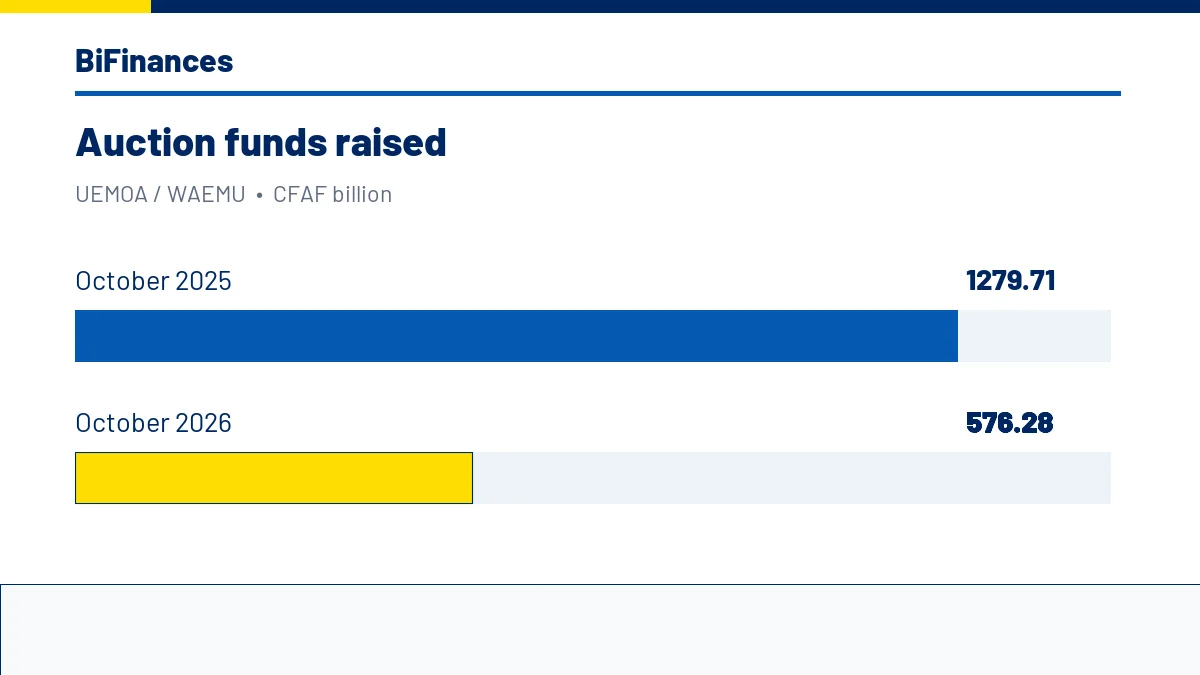
View data
| Category | CFAF billion |
|---|---|
| October 2025 | 1,279.71 |
| October 2026 | 576.28 |
Smaller issuance, stronger bid coverage
The fall in borrowing was also visible month on month. Treasuries raised CFAF870.79 billion in September 2026, CFAF294.51 billion more than in October. Over that interval, average auction coverage increased from 197.61% to 212.13%. The ratio compares submitted bids with the amount sought at each auction, indicating competition for the securities offered rather than the total financing raised over the month.
Funds allocated to intermediaries’ client accounts fell even faster. UMOA-Titres recorded CFAF91.70 billion in October, down from CFAF411 billion a year earlier, a contraction of 77.69%. Their share of monthly funds raised dropped from approximately 32.1% to 15.9%. The remaining allotments were made for the own accounts of eligible market participants, mostly financial institutions.
Bonds dominate the new funding mix
Treasury bonds accounted for CFAF513.81 billion of the October proceeds, while Treasury bills contributed CFAF62.48 billion. Bonds therefore represented about 89.2% of funds raised through auctions during the month. Longer-dated instruments dominated issuance as shorter-term paper played a much smaller role.
The broader 2026 figures point in the same direction. Between January and October, bond issuance totalled CFAF8,377.02 billion, against CFAF2,401.52 billion of Treasury bills. Compared with the corresponding period of 2025, bond funding increased 62.82% while bill issuance decreased 57.10%. UMOA-Titres’ third-quarter report put the average maturity of new borrowing at 3.30 years, before October’s monthly average reached 5.42 years.
In Years
Select a bar to see its details.
Source : UMOA-Titres, octobre 2026
Download CSV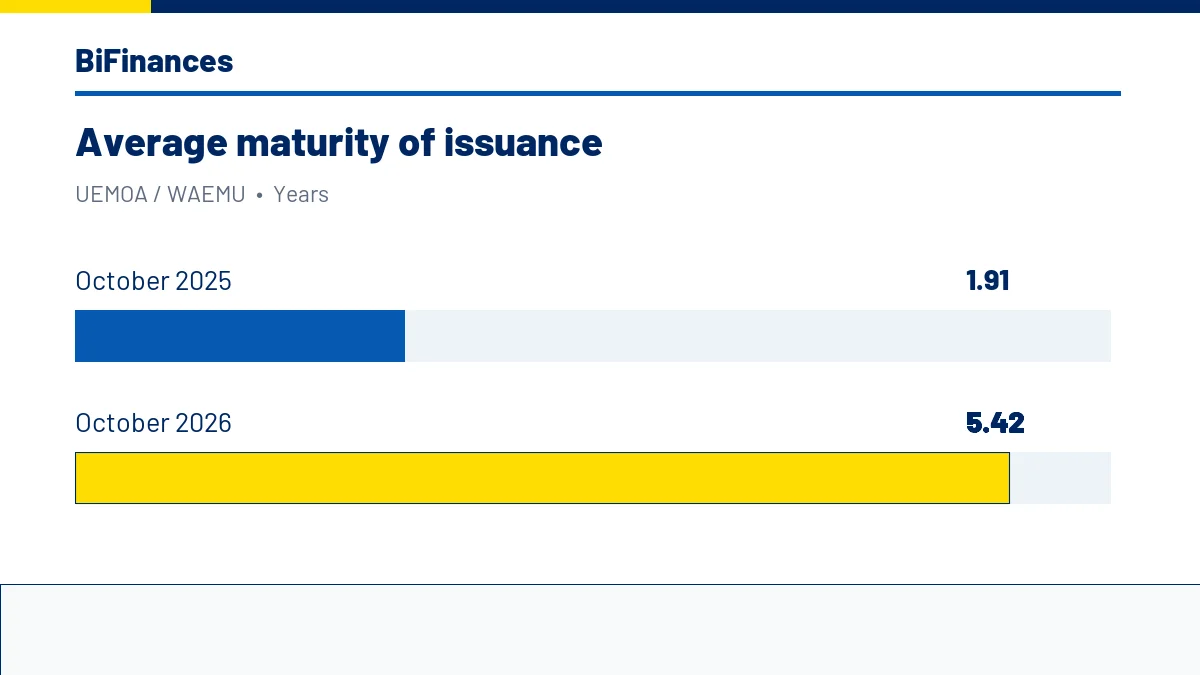
View data
| Category | Years |
|---|---|
| October 2025 | 1.91 |
| October 2026 | 5.42 |
Longer maturities spread principal repayments over a wider time horizon, reducing how often a new bond must be refinanced. Investors, however, price securities according to their term and the issuing government’s borrowing conditions. Treasuries must therefore weigh their repayment calendars against the yield required to place each maturity.
Repayments overtake fresh borrowing
October’s borrowing slowdown coincided with CFAF720.84 billion of repayments. On the auction market, treasuries repaid CFAF144.56 billion more than they raised. The picture had been reversed in October 2025, when CFAF1,279.71 billion of issuance exceeded CFAF521.07 billion of repayments. The monthly cash-flow balance thus swung from a net inflow of CFAF758.64 billion to a net outflow of CFAF144.56 billion.
Across the first ten months of 2026, however, new funds still exceeded payments. Governments had raised CFAF10,778.54 billion and repaid CFAF9,622.14 billion, leaving CFAF1,156.40 billion of net funds on that segment. Outstanding auction-issued government securities stood at CFAF23,888.51 billion on 31 October.
Trading in existing securities remained active. UMOA-Titres’ secondary-market report recorded CFAF619.58 billion in transactions during October across 328 deals. Those trades transfer instruments between holders, while government borrowing proceeds are generated through primary issuance.
Côte d’Ivoire absorbs almost half of the market
Issuance also became highly concentrated among borrowers. Côte d’Ivoire raised CFAF275 billion, or 47.7% of the region’s October total, followed by Senegal with CFAF129.38 billion. Together they accounted for roughly 70.2% of new funds. Mali raised CFAF77 billion, Burkina Faso CFAF40 billion, Niger CFAF39.91 billion and Guinea-Bissau CFAF15 billion.
Benin and Togo held no auctions during the month, although they repaid CFAF47.72 billion and CFAF14.19 billion respectively. Benin’s stock of auction-issued government debt stood at CFAF1,003.59 billion at end-October, down from CFAF1,046.22 billion at end-September. Each government’s financing profile reflects both fresh issues and the maturity of older securities.
The price of a longer horizon
The yields at a single auction show how borrowing costs varied by term. On 20 October, Côte d’Ivoire placed CFAF3.24 billion in twelve-month securities at a weighted average yield of 3.74%. It also raised CFAF39.36 billion in three-year paper at 6.37%, CFAF33.85 billion at five years at 7.03%, and CFAF17.05 billion at seven years at 7.18%, according to UMOA-Titres’ official issuance table.